
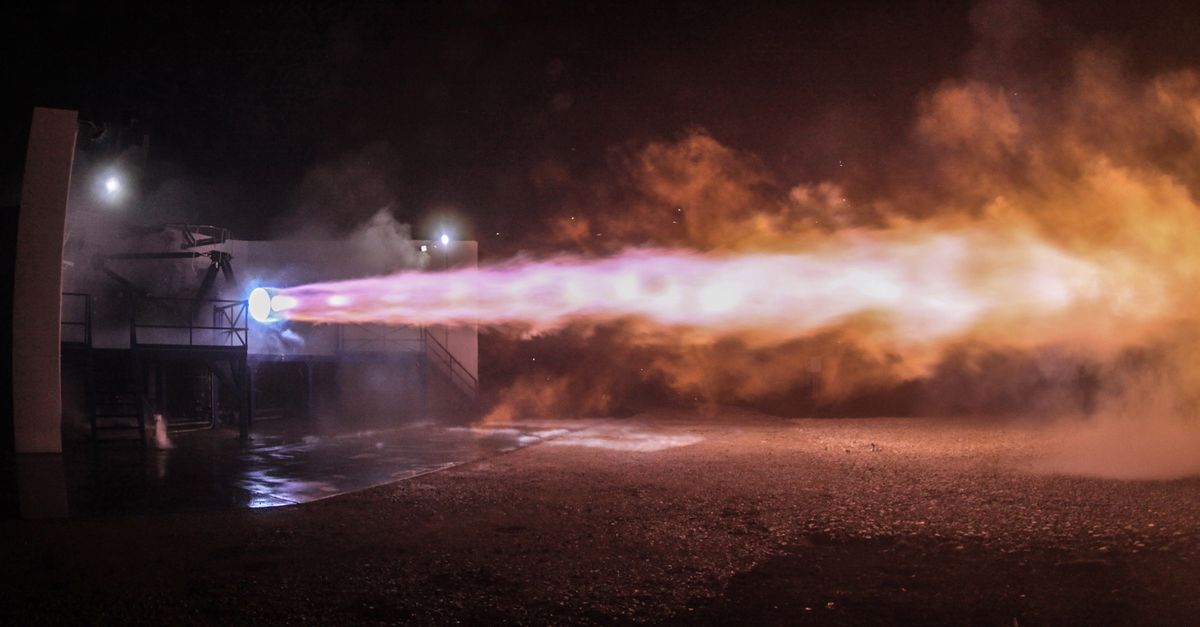
NASA has completed a new hot fire test of an RS-25 rocket engine, part of the agency's ongoing efforts to refine the propulsion system that will power its Space Launch System (SLS) rocket on future Artemis missions to the Moon and, eventually, Mars.
The test took place on November 18, 2026, at NASA's Stennis Space Center near Bay St. Louis, Mississippi, according to the space agency. Engineers fired engine No. 10001 on the Fred Haise Test Stand for a planned duration of 200 seconds — three minutes and 20 seconds — matching the length of time the engines must operate during an actual launch.
While this particular developmental engine will not fly on any mission, the test serves a critical purpose. According to NASA, the hot fire allows engineers from the agency and its prime contractor, L3Harris Technologies, to collect performance data that can be used to improve the engine's reliability and efficiency for future flights.
The RS-25 engine has a long history. Originally developed for the Space Shuttle program, the engine has been modified and upgraded for use on the SLS, where it operates at higher thrust levels than during its shuttle days. For each Artemis launch, four RS-25 engines work together to generate up to 2 million pounds of combined thrust, helping lift the massive SLS rocket off the launch pad at NASA's Kennedy Space Center in Florida.
All RS-25 engines intended for flight are tested and certified as flightworthy at Stennis before they are cleared for use. The tests are conducted by a team of operators from NASA, L3Harris, and Nova Space Solutions, the agency said.
The latest test comes as NASA prepares for the Artemis IV mission, a Moon landing currently planned for 2028. That mission will see astronauts launched aboard the Orion spacecraft atop the SLS rocket, with a destination of the lunar South Pole. NASA has described Artemis IV as a key step in its broader strategy to establish a long-term human presence on the Moon and to build the foundation for the first crewed mission to Mars.
For university students studying aerospace engineering, propulsion, or space policy, the RS-25 test program offers a real-world example of how legacy technology is adapted for new exploration goals. The iterative testing process — firing engines on the ground to validate performance before risking them on crewed missions — is a core principle of human spaceflight engineering that students will encounter in their coursework and, potentially, in their careers.
The Artemis program also represents a significant source of internships, research collaborations, and job opportunities for students at universities across the United States, particularly those with strong engineering and space science programs. NASA's partnerships with contractors like L3Harris and Nova Space Solutions create a pipeline for graduates entering the aerospace industry.
NASA has not announced the exact date of the next RS-25 test, but the agency typically conducts multiple developmental and certification firings per year as part of its Artemis preparation schedule.