
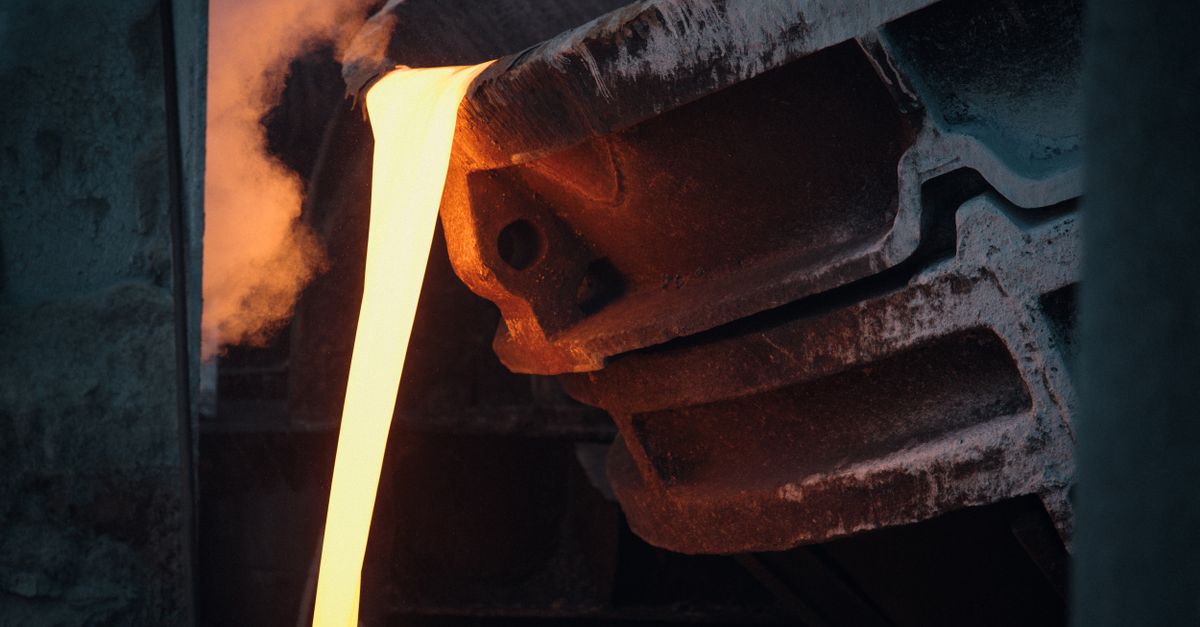
A startup founded by MIT alumni is working to revitalize American metal casting, an industry that has seen more than 70 percent of its facilities close since the 1950s, according to MIT News. Fabri, co-founded by Steven Davis ’24, Thomas Cole ’91, MBA ’13, and Pieter Coulier, combines 3D printing, proprietary software, and vertical integration to streamline the production of metal parts for critical industries like aerospace, defense, and medical devices.
The United States was once the global leader in metal casting, a process in which molten metal is poured into a mold to solidify into a desired shape. Today, China and India dominate production, which is essential for components in jet engines, nuclear and gas turbines, medical implants, and more, MIT News reported.
Fabri’s approach focuses on investment casting, one of the most complex forms of metal casting. Traditional investment casting involves cutting a steel tool, injecting wax patterns, assembling them into a “tree,” and repeatedly dipping the tree in ceramic slurry to create a mold — a process that can take months and cost over $1 million for complex designs, Davis explained to MIT News.
Fabri’s process begins with a computer-aided design (CAD) file. Its proprietary software, FoundryOS, designs a pattern that is printed in resin using digital light processing (DLP) and stereolithography. The printed pattern is then dipped in ceramic slurry to form the shell for molten metal. FoundryOS incorporates data from each step and uses machine learning models to improve the process and parts over time.
“By printing that mold right off the bat, we remove the need for all those early steps,” Davis told MIT News. “We fully automate the creation of the complex patterns and channels needed for making that tree. Instead, we print it all in one piece and consolidate a lot of that work.”
Davis built the first prototype of Fabri’s printer in the basement of his MIT fraternity using funds from the MIT Sandbox Innovation Fund. After subleasing a space in Ashland, Massachusetts, Fabri was pouring metal within six months, according to MIT News. The company opened its first foundry in Ashland in 2025 and moved production to a 16,000-square-foot plant in Billerica, Massachusetts, in spring 2026.
Fabri is already producing parts from aluminum, copper alloys, and stainless steel for customers including Raytheon, Lockheed Martin, and Sikorsky Aircraft, MIT News reported. The company is moving through qualification to make parts for critical aerospace and defense applications. In early 2027, Fabri plans to begin casting nickel superalloys, the metals used in turbine blades that can currently have four-year wait times.
“Qualifying for aerospace production with a company like Raytheon is a really big deal,” Davis said. “Most startups and 3D-printing companies we know haven’t done it. The ability for us to go from opening our first facility in 2025 to now going into production with some of the nation’s most critical platforms is a huge milestone.”
Davis’s path to founding Fabri began with his experience in robotics competitions like BattleBots, where getting parts was the biggest challenge for his small, underfunded teams, MIT News reported. After arriving at MIT in 2020 to study mechanical engineering, he interned at Relativity Space, a rocket company, where he saw multi-million-dollar projects delayed by the same parts shortages.
“I realized the problem was scale,” Davis told MIT News. “These production processes couldn’t even scale to aerospace, so they weren’t going to scale to far larger industries.”
Davis took classes from John Hart, MIT’s Class of 1922 Professor and head of the Department of Mechanical Engineering, who co-founded several additive manufacturing companies and continues to advise Fabri. Davis also visited foundries and heard repeatedly that their biggest bottleneck was labor.
“They all have huge ‘Help Wanted’ signs out front,” Davis said. “Capacity is going down. That’s why we realized automation had to be a core part of our thesis. According to the American Foundry Society, these workers are retiring at a rate of 3-to-1.”
Fabri’s first foundry was designed to be quickly replicated. Even as it expands capacity at its current plant, demand from customers is driving the company to build a far larger facility in 2027 that will produce bigger parts at higher volume as customer programs move into production, MIT News reported.
For university students, Fabri’s story illustrates how additive manufacturing and software are reshaping traditional industries, potentially creating new career paths in advanced manufacturing, materials science, and industrial software. The company’s work also highlights the strategic importance of domestic production capacity for critical components, a topic relevant to students studying supply chains, national security, or mechanical engineering.
“Metal casting is one of the oldest and most prevalent manufacturing methods in the world,” Davis said. “If we get cut off from the world’s casting capacity, that means no more pots and pans, no more storm drains and other basic things, but also no more aircraft. Lots of medical devices, like titanium hip implants, are cast. Power generation also depends on metal parts. These are very critical industries that we need to continue to produce.”